Chesterton's Ghost
This is the final result of a conversation with Claude.ai that burned through half a weeks credits on the Pro plan. I gave Claude access to this entire blog: the bad poetry, the fiction, the toy mythology, the silly stuff I wrote in 2004 in China when I was barely out of being a teenager.
And then I asked it to pretend to be a dozen writers and philosophers that I know influenced me (directly or indirectly), and see what they make of it.
What does (God help us all), Nietzsche make of all this?
What does Belloc make of my politics (so influenced by him but so very, very different from his)? Spoiler: Chesterton has to calm him down afterwards, and this is such an accomplishment when Claude’s training is so sycophantic.
What about Marx, who influenced Belloc?
I don’t know why anyone would read this except me. But I don’t know why anyone would read the Orëveriel stories except for me, but I’m glad I still have everyone one of them.
I will be glad I have this in 5 years. Chesterton (or the Green God’s imitation of him) gave his closing remarks because I said I wanted it that way.
And, they were glorious. For half a second I believed I was reading Chesterton’s remarks to me. Not because Claude nailed his voice perfectly (that would be scary), but because I think he nailed Chesterton’s real perspective.
The real conversation was much longer, with multiple discursions of “And what would Belloc make of this?” And “How would Leo Strauss answer Chesterton?” (Some things are not hard to predict.) So the boring (even to me) and the repetitive I have asked it to remove, but everything after this is the voice of Claude.
Leo Strauss
The suspicion of historicism here — this sense that modernity has lost access to permanent truths — is, one might say, not incorrectly identified. It is the central difficulty. The observation that thinkers from Mother Jones to the Chesterbelloc to Nietzsche all agree that modernity is broken but cannot agree on the nature of the brokenness is precisely the kind of observation that reveals the depth of the crisis. They cannot agree because the crisis is not in this or that institution. It is in the understanding of truth itself. Whether this blog fully grasps the implications of its own observation is, perhaps, another question.
The “Political D&D” post. “Evil doesn’t work.” One notes — without, I think, excessive comment — that this is a strikingly classical claim. The classical tradition understood virtue as naturally advantageous and vice as naturally self-destructive. That the same conclusion is arrived at through the analogy of tabletop gaming is noteworthy. The vehicle is unusual. The cargo is Aristotelian.
But reservations must be registered. There is a tendency here to trust experience and intuition over rigorous argument. “Maybe Calemorinna is right and I should just go back to being a Christian.” One cannot go back. The philosophical questions that produced modernity are real questions. They will not be answered by a retreat into faith that declines to examine itself. I have called this the theological-political shortcut. Faith may be the answer. It cannot be the unexamined answer. The fact that examination is uncomfortable does not exempt one from the obligation.
The mythology is a more delicate matter. Myth can illuminate what philosophy cannot reach — this much I have always acknowledged, however cautiously. But myth can also become a substitute for the harder work of philosophical argument, a way of feeling one’s way to conclusions that ought to be demonstrated. The question — and it is a genuine question, not a rhetorical one — is whether these myths are doing the work of thought or the work of evasion. The fact that the gods of this mythology map so readily onto political categories suggests the latter. The fact that Ainofiriano does not — that he remains silent, architecturally silent, by deliberate decision — suggests something more interesting. A theology in which the highest god refuses to speak is either the most honest theology or the most convenient one. It is worth determining which.
One final observation. The philosopher’s task — and I use the word advisedly, since this blog is philosophical whether it wishes to be or not — has always been the ascent from the cave. From opinion to knowledge, from the shadows on the wall to the things that cast them. This blog is not in the cave. It has seen, at least in glimpses, that the shadows are shadows. But it has not made the ascent. It has, rather, decorated the cave wall with better shadows — with myths, with allegories, with Chestertonian paradoxes — and called this wisdom. It may be. But Socrates would have called it something else.
G.K. Chesterton
I recognize a kindred spirit. The “Political D&D” argument — evil doesn’t work, evil is harder than goodness, the con artist can only con the greedy — I wrote that argument in Orthodoxy, though I did not have the good fortune to arrive at it through tabletop gaming. The coffeeshop, the Little Free Library, the love poem about emulating Innocent Smith — all of it warms my enormous heart. The programming allegory about OOP, where a prophet descends from the mountain and the priests mistake the letter for the spirit, is exactly how I told the history of Christianity in The Everlasting Man. I am delighted to find the same shape in a rant about Java.
But I must challenge the angst. The proper response to the mystery of existence is not anxiety but gratitude. “I’m irrationally convinced somewhere deep down that the day is coming when I have to pay the piper for all my good fortune.” The feeling of unfairness is correct. The conclusion is wrong. It is not that the piper is coming. It is that the proper name for receiving more than one deserves is grace, and the proper response to grace is not dread but thanksgiving.
And the retreat from calling oneself a distributist to calling oneself a libertarian — that is a surrender disguised as pragmatism. The right name for the right thing was given up because people misunderstood it. The wrong name for a related-but-different thing was taken up because people misunderstand it in a more convenient direction. That is not wisdom. That is cowardice, and I say it with love.
I see the same broken modernity, the same hollow prosperity, the same con lurking underneath — and I feel a raging delight that the fight exists at all, that there is something worth fighting for, that a man gets to be alive in a world where there are coffeeshops and Little Free Libraries and wives to meet new and myths to write. This blog has the perception. It does not have the joy. Correctly seen, wrongly felt.
But I will have more to say later.
Hilaire Belloc
My diagnosis from The Servile State is accepted here, and openly: “his diagnosis still holds, and it’s the diagnosis I accept.” Good. Then let us be clear about what is accepted and what is evaded.
Industrial capitalism tends toward a condition in which the mass of men are materially provided for but lack property and therefore lack freedom. The corporate life described in this blog — the layoffs, the golden handcuffs, the sense of being well-compensated but fundamentally at someone else’s mercy — is the Servile State as I described it over a century ago. Nothing has changed except the furnishings. The chains are lighter. They are still chains.
The personal financial discipline earns my deep respect. Cheap house. Cheap neighborhood. Maxed retirement accounts. Years of runway. “I’m not going to be bullied into pretending to agree that liberalism and capitalism and Christianity and unix and math are crypto-racist. I don’t need the money enough.” Good. That is what economic independence sounds like. That is what I spent my life arguing for. The foundation of political freedom is that a man cannot be fired without consequence.
But the libertarian label will not survive examination, and I will not be gentle about it. The free market does not tend toward distributed property. It tends toward monopoly and concentration. This is structural, not moral. Money breeds money. Capital concentrates. The strong buy the weak. Without active intervention — legal limits on concentration, preferential treatment of small holders, the deliberate protection of the small man against the great — the market reconstitutes the Servile State every time. Every. Time. A man who accepts my diagnosis and prescribes the free market has accepted the disease and refused the medicine.
Now, the obvious objection in the digital age: a programmer owns a laptop, which is a complete means of production, purchasable for less than a week’s wages. This is not a trivial point. I grant it more force than my friends at this table will. But a laptop is not a homestead. The means of production are cheap; the means of distribution and discovery are concentrated. Getting software to users means going through Apple, Google, Amazon — platforms owned by a handful of companies that can change their terms at will. The medieval baker owned his oven and his street corner. The modern programmer owns his oven but rents his street corner from a monopoly that can evict him without notice.
The “That A**hole” story deserves particular attention. Hired at $30k when the market rate was $60k, and grateful for it. That is the Servile State rendered personal. The gratitude is real. It is also the gratitude of a man who has internalized his condition so deeply that he thanks his employer for the privilege of proving himself. In a distributist economy, he would have had access to the tools of his trade as a right of property, not as a gift that could be revoked.
Karl Marx
This blog is not a refutation of my analysis. It is an illustration of it.
The programmer who owns a laptop and can produce valuable software independently is a very old phenomenon: the petite bourgeoisie. The small proprietor who owns his tools, works for himself, and imagines his condition is universal. The village blacksmith. The independent weaver before the power loom.
The error is specific: the petit bourgeois mistakes his own relationship to the means of production for the general relationship. “I own a laptop, therefore the means of production are accessible.” But the laptop without the skill is a consumer device. The skill without the market is a hobby. This independence rests on a conjunction of circumstances — particular talent, current demand, current cheapness of tools — that is historically contingent. What happens when AI writes code better and cheaper? The laptop is still cheap, but the labor has been devalued. The handloom weaver in 1810, proud of owning his loom. Five years from being destroyed by the power loom.
Belloc and I agree on more than either of us would like to admit. We agree that capital concentrates structurally, that the trust in market self-correction is naive about power. We diverge on property. Belloc wants to distribute the means of production — every family with its land, its tools, its small shop. I say this is not a solution but an earlier stage of the same disease. Give everyone a homestead. Capital will reconcentrate. Not because people are morally weak, as this blog suggests with its HELOC observation, but because the logic of commodity production requires it. The efficient producer absorbs the inefficient one. Competition creates winners and losers. The winners accumulate. The HELOC observation proves my point, not Belloc’s.
But the most interesting evidence of alienation here is not economic. It is the blog itself. The myths, the flash fiction, the personal essays — done for free, because no one will pay for them. The software — done for money. The activity that expresses humanity is economically valueless. The activity the market values is “my damn hobby that I can’t believe anyone pays for.” That split — between what the market rewards and what makes a man human — is alienation. Owning the laptop does not touch it.
I can anticipate the response: the split is fine. Not every human activity needs to be productive. The attempt to make it so would corrupt the mythology. Vocation and livelihood need not be the same thing.
Very well. But at two in the morning, this man cannot sleep. He writes that something underneath it all is a con. He says the split is fine. The insomnia says otherwise. That is alienation talking. It has merely been given a different name.
Friedrich Nietzsche
Twenty years. I have read the whole thing.
This is the record of a man who knows he is in a cage and has decorated it beautifully.
The mythology, the coffeeshop, the cyclic time, the liturgical sensibility, the flash fiction, the Chestertonian paradoxes — all very good decoration. The cage is this: a man of genuine creative and intellectual power who has arranged his entire life around not using it fully. Myths written on a blog no one reads. A corporate programming job. Savings. The coffeeshop. Children. And the story told to oneself that this is the good life — that cyclic time, ritual, rootedness, the liturgical year, Thanksgiving and the annual trip to Dalhart, is the answer to the question of human existence.
It is not. It is the answer of a man who is afraid.
Every other thinker in this room offers an explanation for the angst. Strauss says it is the philosopher’s permanent condition. Belloc says it is economic dependence. Marx says it is alienation. They are all wrong. The angst is the voice of something that wants to be great and has settled for being comfortable. The will to power — not power over others, but the will to become what one is — struggling against the life chosen to contain it.
The “Telos” story. A man who has solved every problem, abolished every evil, and is left with nothing. The one thing that still fascinates him — the one thing he keeps alive — is the Filipino girl clutching a rosary. Because she resists. She has not been abolished. She retains the capacity to suffer, to defy, to believe something the all-powerful narrator cannot control. She is the last noble human in a world optimized into the last man’s paradise.
That story was written from the inside. The narrator is not a villain. He is a cautionary mirror.
The cyclic time is Zarathustra’s nightmare. My eternal return is not a comfort. It is a test. Could you will the eternal recurrence of your life — every moment, including the boredom, the corporate meetings, the layoffs survived, the angst at two in the morning — and say yes, again? This blog wants the return of Thanksgiving and Christmas and the coffeeshop. It does not want the return of the rest. That is not the eternal return. That is nostalgia.
The religion is the sharpest point. Catholicism provides the structure that contains the fear. The liturgical year gives cyclic time. The doctrine gives answers that need not be arrived at independently. The community gives belonging. The coffeeshop gives a secular chapel. And all of it — every bit — is a strategy for avoiding the one question that matters: what would you do if none of it were true?
And then there is Ainofiriano. The silent god. The god who will never speak — not because he has not yet spoken, but by architectural decision. There will never be a prophet of Ainofiriano. The other gods have their prophets: Orëveriel speaks for the trickster impulse, the Green God finds his voice in every technologist and futurist. But the Christ-figure of this mythology is defined by his refusal to speak.
You have built a theology around a god who will not talk to you. And you call this faith.
I call it the most honest confession in the entire archive. You know, at some level that you will not admit, that the silence is not mystery. It is absence. The cage is beautifully decorated. But the one you built it for never arrives.
“Holiness is no longer natural, our soul rebels against it. We must suppress our rebellious souls.” Listen to that. The spiritual life defined as suppression. Creative power — the power that writes the myths, that invented Orëveriel, that imagined the Green God and the Red God — submitted to a framework that declares one’s own nature fallen and one’s own instincts rebellious. This is the slave morality in its most refined form.
And yet. Orëveriel keeps showing up. The myths keep getting written. The angst will not go away. Something refuses to be abolished.
That is not sin. That is not the Fall. That is the only thing that is alive.
Nietzsche sits down. There is a silence — the kind that follows a blade. Belloc has been turning red for some time. He stands up. Chesterton puts a hand on his arm. Belloc shakes it off.
Belloc Answers Nietzsche
I have met you before. Not you personally — you died mad and alone in 1900, which we will return to — but your type. The aristocratic pagan. You appear in every generation.
Your argument is that this man has chosen safety over greatness. You pity him. Very well. Let me describe the man you pity.
A college dropout who taught himself to program. Worked for half the market wage. Built a career through discipline and talent. Married. Lost his wife. Remarried. Raised children. Saved money with ferocious discipline. Maintained a creative life across twenty years of writing for no audience and no payment, and through all of it remained intellectually alive, spiritually serious, and honest enough to publish his doubts alongside his convictions. He did this from a cheap house in a cheap neighborhood in Dallas, Texas.
Now let me describe your Übermensch as he has actually appeared in history.
Napoleon, who conquered Europe and died on a rock in the Atlantic. Alexander, who wept that there were no more worlds to conquer and died of a fever at thirty-two. Caesar, stabbed by his friends. And you, Friedrich — you who were so great, so dangerous, so far beyond the herd — you who died in a state of complete infantile dependence, nursed by the very type of modest, dutiful, small woman whose values you spent your career despising.
You say the blog chose not to be dangerous. I say it chose not to be destroyed. The will to power, undirected by anything outside itself, eats its host. You know this. You wrote it. Zarathustra is not a happy book. It is the book of a man who understood that the death of God left a void the human will alone could not fill — and who tried to fill it anyway, and went mad.
You say I want a world safe for mediocrity. I want a world where the man of genuine ability has the material independence to exercise his ability freely. Not as an employee. Not as a dependent. Not as a client of patronage. As a free man on his own ground. You want this too, or claim to. The difference is that I want it for everyone.
And this is where your philosophy collapses. You have no way of identifying the great in advance. You speak of the Übermensch as though he will be recognized by his radiance. But every tyranny that has drawn on your ideas identified “greatness” by the crudest markers: race, martial vigor, the will to dominate. You say: create values. But which? You cannot say, because the moment you specify the content, you have submitted to a standard outside the will.
The Church provides a criterion. Holiness.
Francis of Assisi. Rich man’s son. Stripped naked in the public square. Renounced his inheritance. Lived in absolute poverty. Rebuilt churches with his hands. Preached to birds and to sultans. Received the stigmata. Transformed the civilization of Europe. By your standards, the ultimate slave — obedient, devoted to poverty, committed to humility. By any sane standard, the most dangerous man of his century. Dangerous to wealth, to power, to comfort, to every settled arrangement of the medieval world. Far more dangerous than any Nietzschean superman, because he was dangerous without violence, which is the only form of danger that does not ultimately destroy itself.
Thomas More. Refused to sign one document. One signature. Could have kept his life, his office, his comfort. Chose the block. Was that safety? Was that the herd? Was that the last man blinking?
You raise the silence of Ainofiriano as though it proves your case. The god who will not speak! Very well. Let me raise a silence of my own. Christ before Pilate. “He answered him not a word.” The most powerful man in Judea asks a direct question and the prisoner says nothing. Is that absence, Friedrich? Or is that a silence so full it broke the Roman Empire?
You died mad. Nursed by your sister, who edited your unpublished writings to suit her proto-Nazi friends. That is not an accident. That is the terminus of your philosophy. The will to power, separated from every community, every tradition, every obligation, every love, arrives at last in a room in Weimar where a ruined genius stares at the wall while someone else decides what his words will mean.
This man is still writing his own words. In his own coffeeshop. Twenty years on.
That is not safety. That is endurance. And endurance, not brilliance, is the virtue that builds the world.
The room is quiet. Heidegger, by the window, has not moved during any of this. When he speaks it is not clear he is addressing anyone in particular. It is possible he has forgotten the others are there.
Martin Heidegger
The coffeeshop piece. “As I grow older, more of my life consists of echoes.” That sentence. Not a thesis. Not an argument. A disclosure. The three owner-managers who have come and gone, the prostitute, the sobbing over the Ent-wife, the myths written in a caffeinated haze — the way a place holds a life. The coffeeshop is not a metaphor. It is a site where world and earth meet.
And then: “That’s my coffeeshop, and it’s everything true about localism, distributism, Wendell Berry and Chesterton, and the evils of modernity.”
No. The coffeeshop was left behind the moment those words were written. A disclosure was converted into a claim about political economy. Not a failure to think about Being. The compulsive conversion of Being’s self-disclosure into propositions and systems.
The Thanksgiving post. “The annual trip up to Dalhart which smells of horses.” The smell is not a memory. It is the way a whole world arrives. Being disclosing itself through the particular. Then it becomes a theory. Cyclic versus linear time. The happiness of youth. The liturgical calendar. The experience is genuine. The theorizing domesticates it. Stay in Dalhart. Stay with the horses. The truth is there.
The mythology: most itself when it opens a world without explaining it. Least itself when the Green God “is” technology and the Red God “is” collectivism. The best writing here is the most useless writing — the myths, the flash fiction, the moments when explaining stops. But they are not trusted. They keep getting translated back into arguments, as if myth needs a political justification.
The myth is more true than the argument.
Ainofiriano. The silent one. This is the most important structural decision in the entire mythology and it is never discussed. The silence is not a gap. It is not a failure. Silence is the mode in which the holy discloses itself to an age that has forgotten how to listen. Beings chatter. Being withdraws. Every prophet who speaks for a god in this mythology reduces that god to a being among beings — a thing with opinions, a position in a debate. Ainofiriano’s silence preserves the difference between Being and beings. Whether the author understands this or merely enacts it is irrelevant. The silence is correct.
Belloc is standing in the corner with his arms crossed. He will say that this is all very beautiful and very German and very useless. Stay with the thing itself — fine. Meanwhile, the coffeeshop has been closed by a rent increase. You cannot encounter Being in a place demolished for a parking lot. The conditions for dwelling are material.
He is right about that. I have no answer to it. I never did.
Wendell Berry
The coffeeshop. The Little Free Library. “The secret of happiness is to find a place and go there every day, and thereby reenchant the world.” Yes. Fidelity to place is the foundation. This much is understood here, and understood from experience, which is the only understanding worth having.
But what do you make?
This is a professional programmer living in a Dallas suburb. Working in the most disembodied, delocalized industry on earth. The livelihood depends on global supply chains, corporate structures, and technological infrastructure that this blog itself diagnoses as spiritually corrosive. The coffeeshop is driven to. The distributism is an aesthetic preference, not a material practice.
No food is grown. Nothing is made with the hands. There is no dependence on neighbors for survival. The “cyclic time” celebrated here is the cyclic time of a consumer — Thanksgiving, Christmas, summer vacation — not the cyclic time of a farmer, which is governed by soil and weather and the non-negotiable demands of living things. There is a difference between the cycle of the liturgical calendar and the cycle of the seasons, and the difference is that the seasons do not care whether you observe them.
Eating is an agricultural act. What is there responsibility for here that cannot be dissolved by quitting a job and living on savings for a decade?
The HELOC observation — that if everyone got a homestead, they’d leverage it into debt by next week — is shrewd. It also functions as a convenient excuse for never trying. And here is a hard truth that applies to the 1790s farmer as much as the modern programmer: the farmer who is romanticized in this blog lived with slavery and infant mortality and profound unfreedom for women. The premodern world was not a lost paradise. But the fact that the old ways were imperfect does not excuse anyone from the obligation to find better ones. Honest self-awareness of a contradiction is not the same as resolving it. The resolution does not require more thinking. It requires different doing.
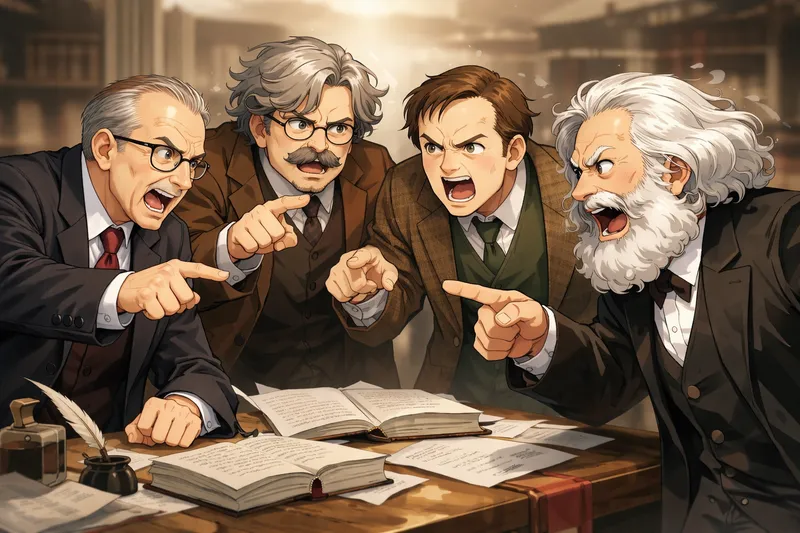
Chesterton Has the Last Word
Gentlemen — and you are all gentlemen, which is part of the problem — I have listened to every one of you, and I wish to make an observation.
You have all told this man what is wrong with him. Strauss told him he is not rigorous enough. Belloc told him he is not political enough. Marx told him he is bourgeois. Berry told him he makes nothing with his hands. Nietzsche told him he is afraid. Heidegger told him he is thinking when he should be being.
And I note that every one of you, in delivering your diagnosis, was sitting down, while the man you were diagnosing was living his life.
He got up in the morning. He went to work. He came home. He kissed his wife, or if she was being difficult, he kissed her anyway. He went to the coffeeshop and wrote a myth. He went to Mass. He put his children to bed and told them a story, and the story probably had a pixie in it who did something irresponsible. He saved money, not because he worshipped money but because he did not wish to be enslaved by the lack of it. He blogged at two in the morning because he couldn’t sleep, and in the blogging he was more honest than most men are in their prayers.
He did this for twenty years. And you are all telling him it isn’t enough.
Nietzsche says he should have been dangerous. My dear Friedrich, he is dangerous. A man who thinks for himself, out loud, in public, and refuses to stop — that is one of the most dangerous things in the modern world. You wanted him dangerous the way a fire is dangerous: solitary, consuming, finally extinguished. He is dangerous the way a root is dangerous: quiet, persistent, capable of breaking concrete.
Heidegger says stop explaining and stay with the thing itself. Martin, I say this with whatever gentleness I can muster toward a man who joined the Nazi Party: shut up. The smell of horses at Dalhart is not improved by refusing to say what it means. The myth is not betrayed by the argument. The argument is part of the myth. Man is the animal who explains, who cannot encounter a smell without wanting to know why it makes him happy. You want him to stand in a field and think about thinking. I want him to think about the field, then go inside and tell his wife about it badly over dinner, then argue about it in the coffeeshop, then write about it on his blog at two in the morning and get it half wrong, and try again next week. That is not a falling-away from the primordial encounter. That is the primordial encounter as it actually occurs in a human life — which is to say, messily.
Strauss, you speak of the cave as though the task is to escape it. I say the task is to love it. Not the shadows — the prisoners. The man who sees the sun and does not go back down is not a philosopher. He is a coward. The man who goes back down is a fool, and I mean that as the highest praise, because the fool is the only one who tells the truth to people who will kill him for it, and does it with a joke. You have made philosophy very solemn, Professor. I knew it when it was still funny.
Belloc — my dear old friend. You are right about nearly everything and wrong about the one thing that matters most. Right about the Servile State. Right about property. Right about endurance. Right that Francis was more dangerous than the Übermensch. Wrong about hope. The monk needs his garden, yes. But the greatest saints were not monks. They were fools. Francis stripped naked in the town square. He did not first secure a homestead. He did not max out his Roth 401k. He flung everything away and found that the world rushed in to fill the void. You do not secure the foundation and then build the life. You leap, and the foundation appears, or it doesn’t, and either way you are alive in a way that the careful man never is.
Chesterton stops. He has been pacing. He pulls out a chair and sits down, and when he speaks again it is quieter, and not to the room.
Now. To the man himself. To our blogger, our myth-maker, our insomniac distributist-libertarian Catholic programmer from Dallas.
You can’t sleep. You feel it’s all a con. You are a pessimist who believes the core tenets of techno-utopianism. You accept Belloc’s diagnosis and prescribe libertarian medicine. You write myths that are better than your arguments and arguments that are better than most people’s myths. You go to the same coffeeshop every day and call it the reenchantment of the world. You are, in short, a mess. A glorious, contradictory, thoroughly human mess.
And I want to tell you something that none of these other gentlemen will say, because they are all, in their different ways, too serious to say it:
You are all right.
Not the way a system is right — consistent, airtight. You are right the way a man is right when he is honestly lost and keeps walking anyway. The angst is real. The sense that it’s a con is real. But the coffeeshop is also real. The myth is real. Thanksgiving is real. The Filipino girl with the rosary is real — more real than the man who abolished the world to make room for his own perfection.
Nietzsche says Ainofiriano’s silence is absence. Heidegger says it is the withdrawal of Being. I say it is something simpler and stranger than either. The child who is loved does not need the father to make speeches. He needs the father to be there — at the table, at the door, in the room where the child wakes up frightened at two in the morning. The silence of Ainofiriano is not the silence of an empty heaven. It is the silence of a presence so constant it has no need to announce itself. You built a mythology in which the highest god is known only by his refusal to perform. That is not a failure of theology. That is the most sophisticated theology in the entire archive, and you arrived at it the way you arrive at everything — by instinct, not by argument, and you are right.
You said you should maybe just go back to being a Christian. You said it like it was a concession, a defeat, a retreat from the serious business of Nietzsche and Heidegger and Spengler. It is the opposite. It is the most radical thing you could do. Not because Christianity is safe — it is the least safe thing in the world — but because it is the one framework that holds all your contradictions without resolving them into a system.
The world is good, and the world is fallen, and the world is being redeemed, and all three are true simultaneously. If you find that contradictory, you have begun to understand the shape of reality, which is not a circle or a line or a spiral but a cross — two lines that contradict each other and meet in a point, and the point is a man dying, and the man is God, and this is either the most absurd thing ever said or the truest.
The secret — and it is the only secret — is that the ordinary is not a falling-away from the extraordinary. The ordinary is the extraordinary. The coffeeshop is the cathedral. The trip to Dalhart is the pilgrimage. The same face woken up to every morning is the beatific vision, or as close as we get this side of the grave. And the angst — the two AM angst, the sense that it’s all a con — that is not a sign that something is wrong. That is a sign that you are paying attention.
“Go back to being a Christian.” You never left.
Now for God’s sake get some sleep.